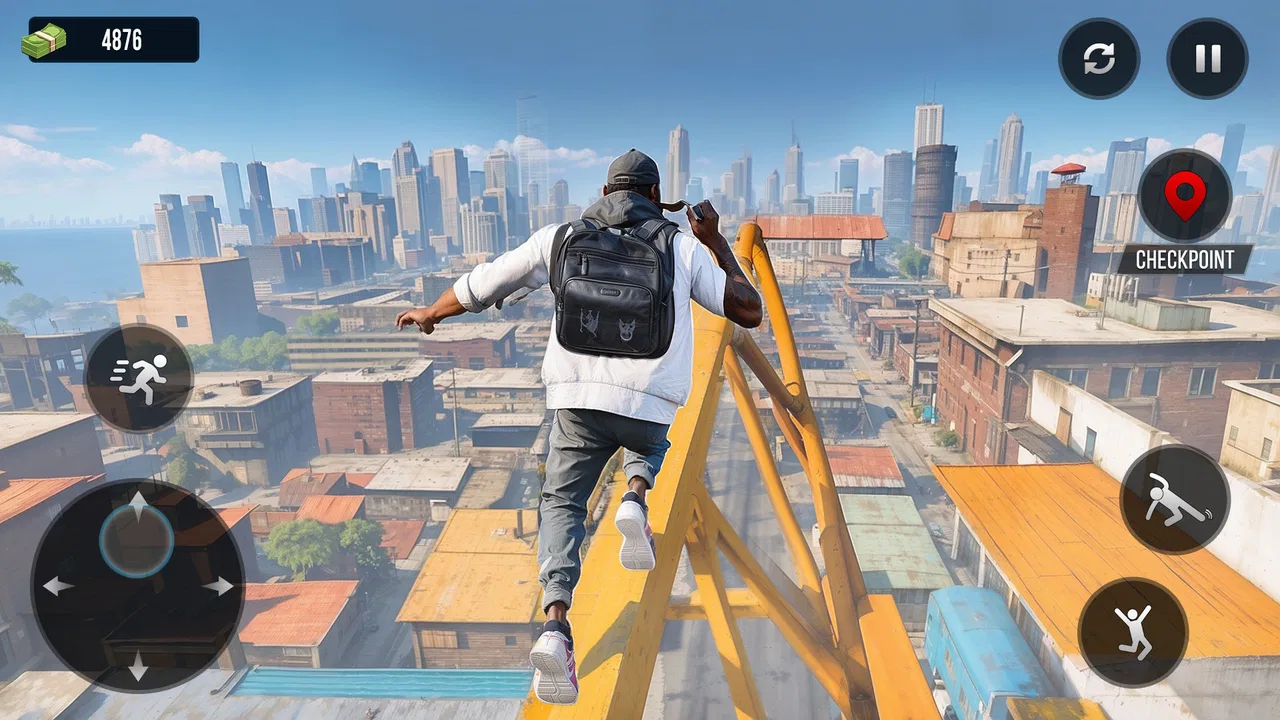
Only Going Up 3D- Parkour Game
- 4.2
- Rating
- 1.00M
- Installs
- Free
- Price

 Analysis by App-foxy
Only Going Up 3D is a free role-playing game from Gaming Mob that focuses on one clear idea: climbing through rooftop parkour routes while trying not to lose your progress. I found the appeal in its simplicity. There is no long setup to understand before playing; the main challenge is reading the next platform, controlling the character in midair, and deciding whether to advance carefully or take a risk.
That narrow focus makes it easy to pick up, but it also defines the experience. This is not the right choice if you want a deep character-building adventure, a large story, or a broad collection of role-playing systems. It is better understood as a short-session climbing challenge with a game-like progression feel. The store presents it as a 3D rooftop parkour game, and that description is more useful than treating it like a traditional role-playing journey.
Why the upward-climbing challenge matters
The central capability is vertical movement. Instead of sending me across a conventional map with a clear road from one mission to another, the game asks me to keep going upward through elevated routes and alley-like spaces. That changes how I play. I am not simply looking for the next objective; I am constantly judging height, distance, landing space, and the safest line forward.
You May Also Like

 Blood Strike: 2.5 Anniversary
Blood Strike’s Loadouts Turn Every Drop Into a Tactical Gamble
A close look at Blood Strike’s custom loadouts: how fast access to signature weapons reshapes its battle royale rhythm, rewards preparation, and narrows the gap between fights.

 Pandora - Music & Podcasts
Pandora’s Music Is Easy to Start, but Harder to Recover
Pandora’s strength is its low-effort path from a seed to a station. Its weak spot is how much confidence it asks you to place in connection, setup, and quiet recovery.

 8 Ball Pool
 Is Built on Rivalries, Rematches, and Routine
A close look at the rivalries, rematches, shared routines, and unanswered safety questions that turn a quick pool match into a persistent mobile community.

 Samsung Music
’s Quiet Strength Is Playing What You Already Own
Its reach comes less from spectacle than from dependable access to a personal library. That simplicity is both the app’s strongest retention engine and its ceiling.

 AccuWeather: Weather Radar
AccuWeather Review: A Quick, Clear Forecast for Everyday Decisions
For everyday plans, the best forecast is the one you can understand quickly. AccuWeather makes rain timing, radar, and local conditions easy to act on, with a few trade-offs.

 Hill Climb Racing
Why Hill Climb Racing Still Turns Crashes Into One More Run
A tiny car, a bumpy hill and one more upgrade: Hill Climb Racing keeps resurfacing because its simple chaos makes every near-miss feel personal.
More From Our News Desk
View All News


In practice, the upward structure creates a natural risk-and-reward loop. A higher position feels valuable because it represents progress, but moving quickly can make a mistake more likely. I often found myself slowing down before a jump, checking where the character would land, and choosing a less dramatic route when one was available. That small decision is where most of the tension comes from.
The strongest part of Only Going Up 3D is the way vertical progress turns ordinary movement into a decision. A flat obstacle course can be entertaining, but climbing makes errors feel more meaningful. Falling is not just a failed jump; it interrupts the rhythm I had built and forces me to regain concentration before trying again.
This focus also makes the game suitable for players who enjoy testing their coordination without committing to a long campaign. I can play for a short period, concentrate on a difficult section, and stop without needing to remember a complicated plot or manage a large inventory. For someone who likes games built around repeated attempts and gradual improvement, that is a practical advantage.
How the movement works in everyday play
The basic experience is easy to understand: guide the character through a three-dimensional route, use platforms and rooftop spaces to continue upward, and avoid misjudging the next move. The challenge is not learning a large collection of abilities. It is learning how the environment behaves and becoming more consistent with movement.
My most useful habit was to stop treating every jump as a race. When I rushed, I paid less attention to the landing area and made avoidable mistakes. When I paused briefly, I could separate the route into smaller decisions: where to stand, which direction to face, how far to move, and whether the next platform offered enough room for a safe landing.
This is also where the 3D presentation matters. Depth can make a platform look closer or farther away than expected, especially when several rooftop elements overlap visually. I learned to use the camera view as part of the challenge rather than relying only on the character’s position. A quick adjustment before a jump can be more useful than immediately pressing forward.
For new players, I would recommend spending the first few attempts learning the rhythm instead of trying to reach the highest point as quickly as possible. The game becomes less frustrating once movement is treated as a sequence of controlled corrections. Small improvements matter: approaching the edge at a better angle, leaving enough space to recover, and avoiding unnecessary jumps when the route already provides a safer option.
One less obvious benefit of this design is that it gives the game a clear stopping point for each session. I can use it during a short break, on public transport, or after finishing a task when I want something active but not mentally demanding in the way a story-heavy role-playing game can be. The game asks for attention, but not for a large time investment in menus, dialogue, or planning.
A realistic short-session scenario
Imagine having ten minutes before an appointment. A conventional role-playing game may be awkward because you might be in the middle of a quest, a conversation, or a battle that cannot be paused comfortably. Only Going Up 3D fits that gap better. I can start a climb, focus on one difficult sequence, and stop after an attempt without feeling that I have abandoned a major narrative moment.
The same quality works for someone who wants a quick change of pace after studying or working. The game provides a direct objective: keep climbing. I do not need to decide which character to build or which mission to accept. That makes it approachable when I want a focused challenge rather than a large decision-making session.
There is a trade-off, though. A short-session game can also feel repetitive if the central movement challenge does not hold your attention. Players who need frequent story developments, new combat systems, or a wide variety of activities may run out of reasons to continue sooner than parkour fans will. The simple structure is both the reason it is accessible and the reason its audience is narrower.
What the game feels like beside other role-playing choices
Compared with the usual mobile role-playing alternatives, this game is much more immediate. Many role-playing titles lead with character statistics, equipment, quests, battles, or dialogue. Here, the main test is physical control and route selection. That makes it a better fit for someone who wants movement to be the center of play rather than a supporting activity between menus.
It is also less suitable for players who measure progress through character customization. If your favorite part of a role-playing game is comparing equipment, unlocking abilities, or shaping a party, this rooftop-focused experience may feel limited. A more traditional role-playing game would offer more variety and a stronger sense of long-term development.
On the other hand, players who find menu-heavy games tiring may appreciate the cleaner objective. The game does not need to compete with a complex fantasy campaign to be worthwhile. Its value comes from giving one activity enough focus to make each successful movement feel earned.
I would describe it as a useful alternative to endless casual games that ask for little concentration. It is still approachable, but it gives me a reason to pay attention. The difference is important: I am not merely tapping through a passive sequence; I am trying to improve my control and judgment from one attempt to the next.
Where the friction appears
The biggest limitation is the same feature that gives the game its identity: the experience revolves around climbing and parkour. If that core loop does not appeal to you, there may not be enough variety to change your mind. The game cannot hide behind a large story or a collection of unrelated modes, so your enjoyment depends heavily on whether you like repeating movement challenges.
Precision can also become frustrating. A jump that looks simple may require more care than expected because the landing position matters. When I failed, the cause was not always immediately obvious. Sometimes I had moved too early; other times I had approached from an awkward angle. That uncertainty can encourage experimentation, but it can also make a failed attempt feel less satisfying than a clearly explained mistake.
Another trade-off is the balance between speed and control. Moving quickly feels exciting, but it reduces the time available to correct a poor line. Moving cautiously improves reliability, yet it can make the climb feel slower. I found that the best approach was not to choose one style permanently. I used caution around unfamiliar sections and increased my pace only after I understood the route.
Players who expect a polished, expansive role-playing package should set their expectations accordingly. Gaming Mob presents a focused game rather than a broad adventure. That is not automatically a weakness, but it means the purchase decision should be based on the parkour challenge itself, not on assumptions about the role-playing label.
Practical tips for more consistent climbs
First, avoid making a jump simply because it is possible. Before moving, I look for the platform that gives the most room to recover. A slightly longer route can be better than a direct leap if it reduces the chance of falling. This is especially helpful when I am still learning how the three-dimensional perspective affects distance.
Second, use failed attempts as route practice rather than treating them as wasted time. I try to identify one specific cause for each mistake: poor positioning, excessive speed, or a late change of direction. That turns repetition into a small training routine. Without that discipline, it is easy to repeat the same error while blaming the level.
Third, separate observation from movement. When I reach a new rooftop area, I pause long enough to understand the next landing space. This is a simple habit, but it prevents the common mistake of continuing forward before the route is visible. The game rewards attention more than blind momentum.
Finally, play in short focused sessions when frustration starts to replace concentration. Because the game is free and designed around a direct climbing objective, there is little benefit in forcing a long session after several careless falls. Returning later with a clear head can be more effective than repeating the same section while impatient.
Who will get the most from it
Only Going Up 3D is a good match for players who enjoy obstacle courses, vertical exploration, and the satisfaction of improving through repeated attempts. It also suits people who want a free game with an Everyone age rating, a straightforward premise, and no need to learn a complicated fictional world before starting.
Its audience is likely to include casual players who enjoy quick challenges, as well as parkour fans who prefer movement over combat. The game can also work for someone looking for a low-commitment alternative to larger role-playing titles. With more than one million installs and an average rating of 4.3 from around six and a half thousand ratings, it has clearly attracted a substantial audience, though those figures should be read as signs of interest rather than a guarantee that every player will enjoy the narrow format.
The current version is 2.9, and the game runs on Android versions from 7.1 onward. That makes it accessible to people using older compatible devices, although the quality of any 3D game can still depend on the individual phone or tablet. If your device struggles with three-dimensional games, I would keep expectations modest and avoid assuming that the experience will feel identical across every screen.
The price is one of its easiest advantages: it is free to play. That lowers the risk of trying it, especially if you already know that rooftop movement appeals to you. The sensible approach is to treat the first session as a test of the core loop. If controlling jumps and planning upward routes feels satisfying, the game has a clear reason to stay installed. If the repetition feels dull immediately, the absence of a deeper role-playing layer is unlikely to change that reaction.
My final recommendation
I recommend Only Going Up 3D to anyone who wants a direct, movement-centered challenge rather than a full-scale role-playing adventure. Its best quality is not the size of its world or the number of systems it offers; it is the way a simple upward route makes every landing matter. I enjoyed the moments when careful positioning turned a risky section into a clean climb.
I would skip it if your priority is storytelling, character customization, combat variety, or long-term strategic progression. In those cases, a conventional role-playing game will give you more to manage and more ways to develop a play style. But if you want a free game that can fill a short break with focused parkour attempts, this one has a clear purpose and stays close to it.
My advice is to play patiently, judge each landing before committing, and decide based on the movement itself. If the satisfaction of reaching the next rooftop is enough to keep you trying, Gaming Mob’s game offers a simple and accessible challenge. If you need constant novelty, it is better viewed as a quick side game than as your main role-playing experience.
FAQs for Only Going Up 3D- Parkour Game
01What is Only Going Up 3D - Parkour Game about?
Only Going Up 3D is a thrilling parkour game where players navigate complex 3D environments using a variety of moves and jumps. The game challenges players with progressively difficult levels, requiring precision and timing to master each course. It's perfect for those who enjoy action-packed gameplay and testing their reflexes.
02Is Only Going Up 3D suitable for all ages?
The game is designed to be fun and challenging for a broad audience, including both younger players and adults. However, it might be more suitable for teenagers and older due to the complexity of the parkour maneuvers and the fast-paced nature of the gameplay, which requires quick reflexes and strategic thinking.
03Are there in-app purchases in Only Going Up 3D?
Yes, Only Going Up 3D includes in-app purchases. Players can buy various items such as skins, boosts, and other customization options to enhance their gaming experience. While these purchases can provide advantages, they are optional, and the game is enjoyable without them.
04Does Only Going Up 3D require an internet connection to play?
Only Going Up 3D can be played offline, allowing players to enjoy the game without an internet connection. However, certain features like leaderboards and social sharing may require connectivity. Playing online might also unlock additional content or updates from the developers.
05What devices are compatible with Only Going Up 3D?
Only Going Up 3D is available on both Android and iOS devices. It is compatible with most modern smartphones and tablets, but it's recommended to check the app store for specific system requirements to ensure smooth gameplay and the best experience possible.
Pros
- Intuitive controls for easy gameplay.
- Vibrant graphics enhance visual appeal.
- Challenging levels keep users engaged.
- Smooth performance with minimal lag.
- Regular updates with new content.
Cons
- Occasional ads disrupt gameplay flow.
- Limited character customization options.
- Requires internet for some features.
- Some levels feel repetitive.
- In-app purchases can be pricey.

Only Going Up 3D- Parkour Game
Gallery